German lessons · German grammar · A2
nicht or kein? How to say no in German
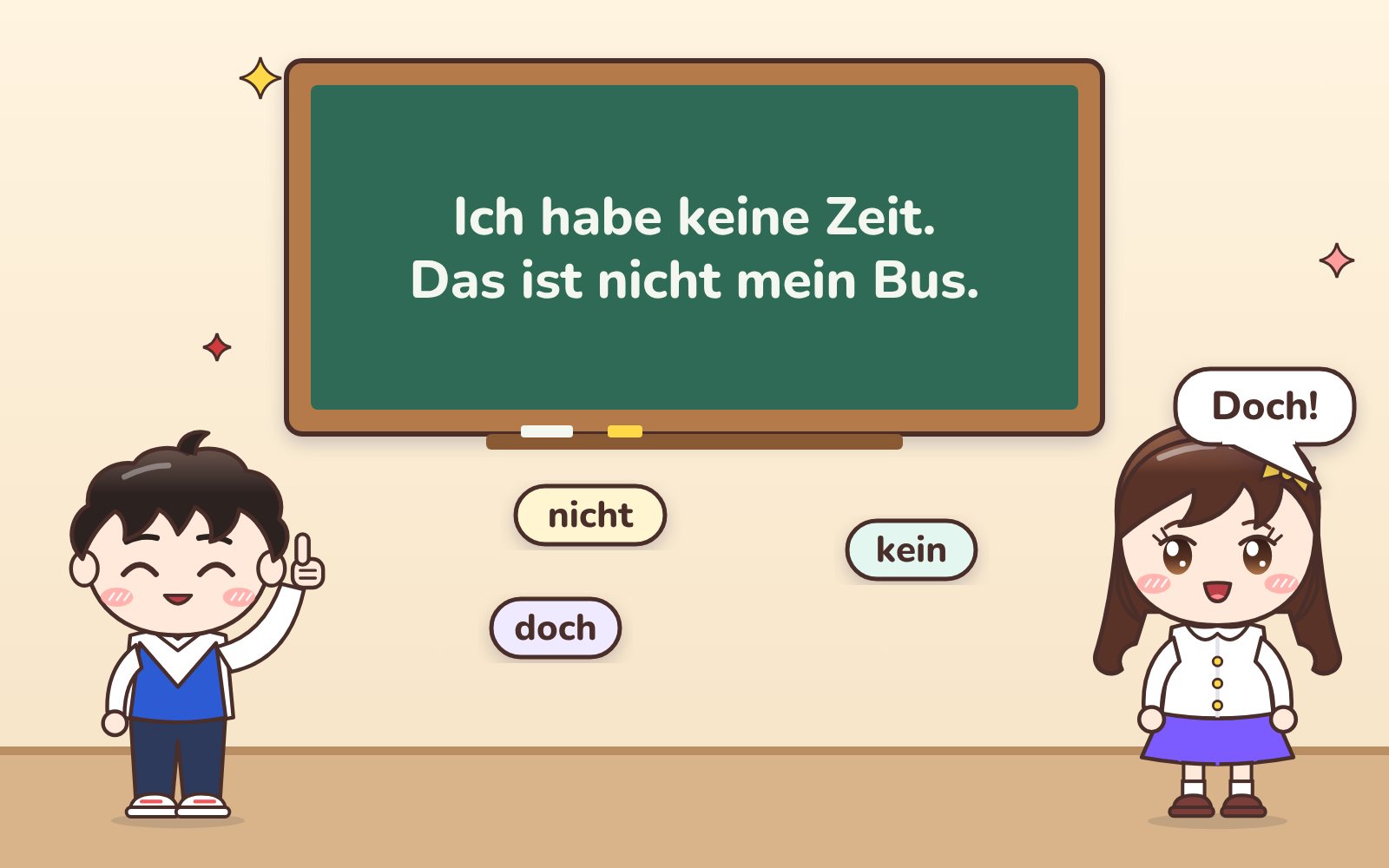
"I don't have a car" in German isn't Ich habe nicht ein Auto but Ich habe kein Auto. Yet "I'm not tired" is Ich bin nicht müde. German has two main words for saying "not": kein and nicht. Which one you use depends on what you're negating. Once you know the rule, it's simpler than it looks. At the end we'll also look at doch, a little word for answering negative questions.
kein: before nouns with ein or with no article
When a noun has ein in front of it or no article at all, use kein. It means "no, not a, not any", and it changes its ending just like ein. It works in the plural too.
| Case | Masculine | Feminine | Neuter | Plural |
|---|---|---|---|---|
| Nominative | kein | keine | kein | keine |
| Accusative | keinen | keine | kein | keine |
| Dative | keinem | keiner | keinem | keinen |
- Ich habe keinen Termin. — I don't have an appointment. (einen Termin → keinen Termin)
- Das ist keine gute Idee. — That's not a good idea.
- Wir haben keine Kinder. — We don't have any children. (plural with no article → keine)
- Ich trinke keinen Kaffee. — I don't drink coffee. (noun with no article → keinen)
- Hast du kein Geld dabei? — Haven't you got any money on you?
nicht: everything else
Use nicht to negate verbs, adjectives and adverbs, nouns with der/die/das or mein, dein and so on, and names. nicht never changes its form.
- Ich bin nicht müde. — I'm not tired. (adjective)
- Er arbeitet heute nicht. — He isn't working today. (the whole verb)
- Das ist nicht mein Fahrrad. — That's not my bike. (noun with mein)
- Ich kenne den Film nicht. — I don't know the film. (noun with den)
- Das ist nicht Anna, das ist Lena. — That's not Anna, that's Lena. (name)
Where does nicht go?
This is the slightly tricky part. Here are the basic rules:
| Situation | Where nicht goes | Example |
|---|---|---|
| Negating the whole sentence | near the very end (after the object and time) | Ich kaufe das Brot nicht. |
| Verb in two parts | right before the second verb part | Ich habe das Brot nicht gekauft. |
| Separable verb | right before the separated prefix | Der Zug fährt nicht ab. |
| Adjectives, places and directions | right before that word | Ich wohne nicht in Berlin. |
| Negating just one part | right before that word (often followed by sondern, "but rather") | Ich fahre nicht heute, sondern morgen. |
- Ich kann heute nicht kommen. — I can't come today. (before kommen)
- Der Bus ist noch nicht angekommen. — The bus hasn't arrived yet.
- Wir gehen nicht ins Kino. — We're not going to the cinema. (before the direction)
You'll hardly ever hear nicht ein. It's only used for emphasis, to mean "not a single one", as in nicht ein einziges Mal (not one single time).
Answer negative questions with doch
Someone asks "Aren't you coming?" and you want to say "Yes, I am!" In English you just say yes. In German you don't use ja here but doch. It's a special answer used only to contradict a negative question or statement.
| Question | Agreeing (no, I'm not) | Contradicting (yes, I am) |
|---|---|---|
| Kommst du nicht mit? (Aren't you coming?) | Nein, ich komme nicht mit. | Doch, ich komme mit! |
| Hast du keinen Hunger? (Aren't you hungry?) | Nein, ich habe keinen Hunger. | Doch, ich habe Hunger. |
So English and German work the same way here: no agrees with the negative, yes turns it around. German simply has its own word for that "yes": remember nein = "the negative stands", doch = "the negative is wrong". If you answer a negative question with ja, it's unclear what you mean.
Common mistakes
- ✗ Ich habe nicht Zeit. → ✓ Ich habe keine Zeit. (noun with no article, so kein)
- ✗ Ich nicht verstehe das. → ✓ Ich verstehe das nicht. (nicht comes after the verb, usually near the end)
- ✗ Kommst du nicht? — Ja, ich komme! → ✓ Doch, ich komme!
Quick check
- Ich habe heute ___ Lust. (nicht / keine)
Answer
keine — die Lust is a noun with no article, so it's keine Lust.- Put the words in the right order: (gekauft / habe / nicht / Ich / die Milch)
Answer
Ich habe die Milch nicht gekauft. — nicht goes right before the second verb part, gekauft.- "Du bist nicht in Berlin, oder?" — How do you answer "Yes, I am in Berlin!"?