Life in Germany · Life & culture
Getting sick in Germany during cold season — sick notes, pharmacies and home remedies
One sneeze, one "Gesundheit!"
Late October, someone sneezes on the U-Bahn and the stranger next to them says "Gesundheit!" (health!). The answer is a simple "Danke!". Once winter time starts and the days get short, Germany is in full cold season (Erkältungszeit). When the first colleagues start sniffling, you will hear one phrase a lot: "Bleib zu Hause!" — stay at home. Coming to work ill is seen less as dedication and more as passing it on to everyone else.
First step: tell your employer, then get a note if needed
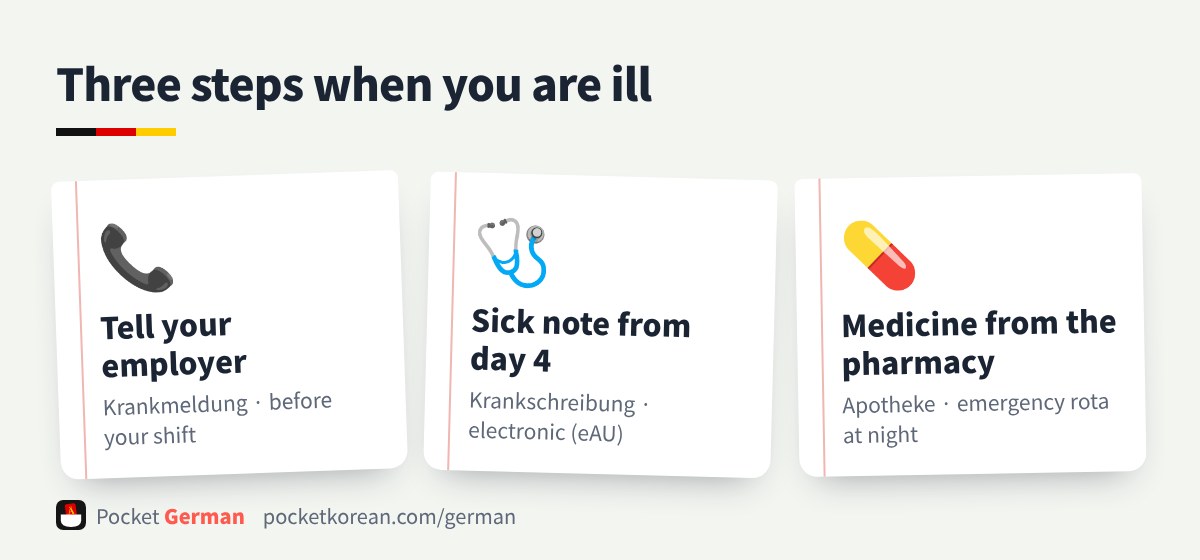
Germany separates two things. A Krankmeldung is telling your employer right away that you can't work. A Krankschreibung is the doctor's sick note.
- Usually you need a note from the fourth day of illness. Your employer may ask for one from day one, so check your contract or company rules.
- With statutory health insurance, sick notes have been electronic (eAU) since 2023. Your employer fetches it from your insurer, so there is no paper to hand in — but telling your employer is still up to you.
- For mild illness, a practice that already knows you (you were there in the last two years) can sign you off by phone for up to five days. It is not a right, so practices differ, and politicians are debating whether to scrap it — check the current rules.
Medicine comes from the Apotheke
If you are used to buying cold medicine at the supermarket, Germany may surprise you. Most over-the-counter medicines, painkillers and cold remedies included, are sold only in pharmacies (apothekenpflichtig). Drugstores like dm and Rossmann stock vitamins, teas and sweets, not much more. In return, the pharmacist will ask about your symptoms, pick something suitable and explain how to take it. Prescription medicine needs a doctor's Rezept.
Most pharmacies close at night and on Sundays, but each area has a rota of emergency pharmacies (Notdienst-Apotheke). Today's one is posted on every pharmacy door and can be found online.
Ill at night or at the weekend: 116117
When practices are closed and you need a doctor but it is not an emergency, call 116117, the nationwide out-of-hours medical service. They point you to the nearest on-call practice or give advice. If it is life-threatening — trouble breathing, losing consciousness — call 112 straight away.
| Situation | What to do |
|---|---|
| Fever in the morning, can't work | Tell your employer before your shift starts (Krankmeldung) |
| Likely off for more than three days | Get a sick note from a doctor (check company rules) |
| Need cold medicine or painkillers | Ask at the pharmacy and describe your symptoms |
| Need medicine on a Sunday night | Find the Notdienst-Apotheke |
| Need a doctor at night or weekend | 116117 |
| Short of breath or an emergency | 112 |
German grandma remedies
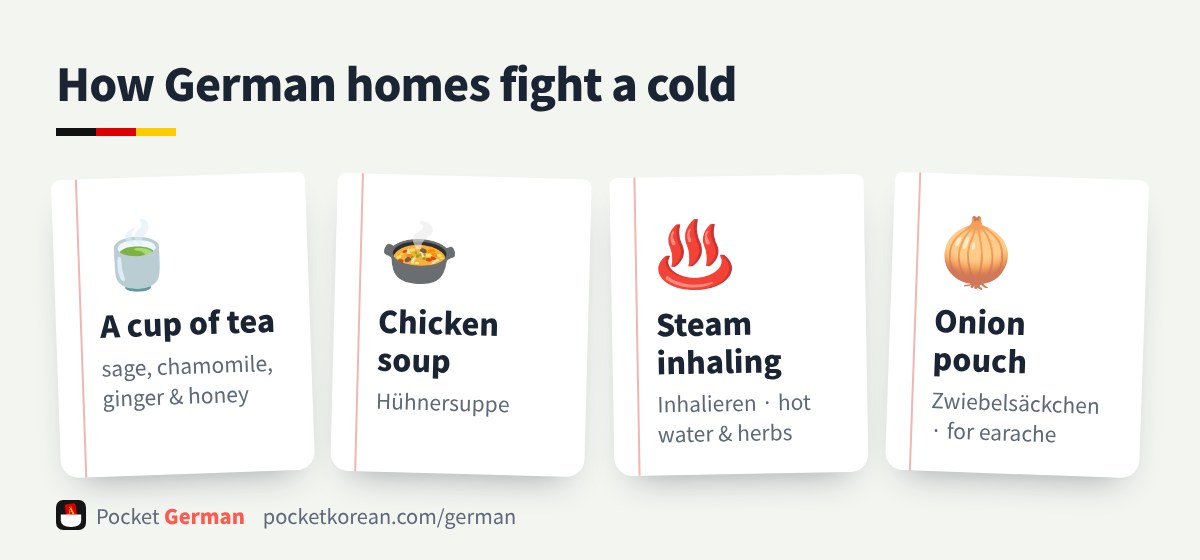
Instead of medicine (or alongside it), German households have their own favourites. Top of the list is tea: sage tea (Salbeitee) for a sore throat, chamomile (Kamillentee) for a sore stomach, ginger with honey for everything. Supermarkets even have a shelf of "cold tea" (Erkältungstee). Parents cook chicken soup (Hühnersuppe), and many people inhale steam from hot water with herbs. Some tricks are more surprising, like the Zwiebelsäckchen — warm chopped onion wrapped in cloth and held against an aching ear. Results vary from person to person, so see a doctor if it drags on.
Today's German words
| Word | Meaning |
|---|---|
| die Erkältung | a cold |
| die Krankmeldung | calling in sick |
| die Krankschreibung | doctor's sick note |
| die Apotheke | pharmacy |
| das Rezept | prescription (and also a recipe!) |
| Gute Besserung! | Get well soon! |
For a friend or colleague who is ill, "Gute Besserung!" is all you need to say. Stay healthy this winter!