German lessons · German grammar · A2
Bigger, Biggest: German Comparatives and Superlatives
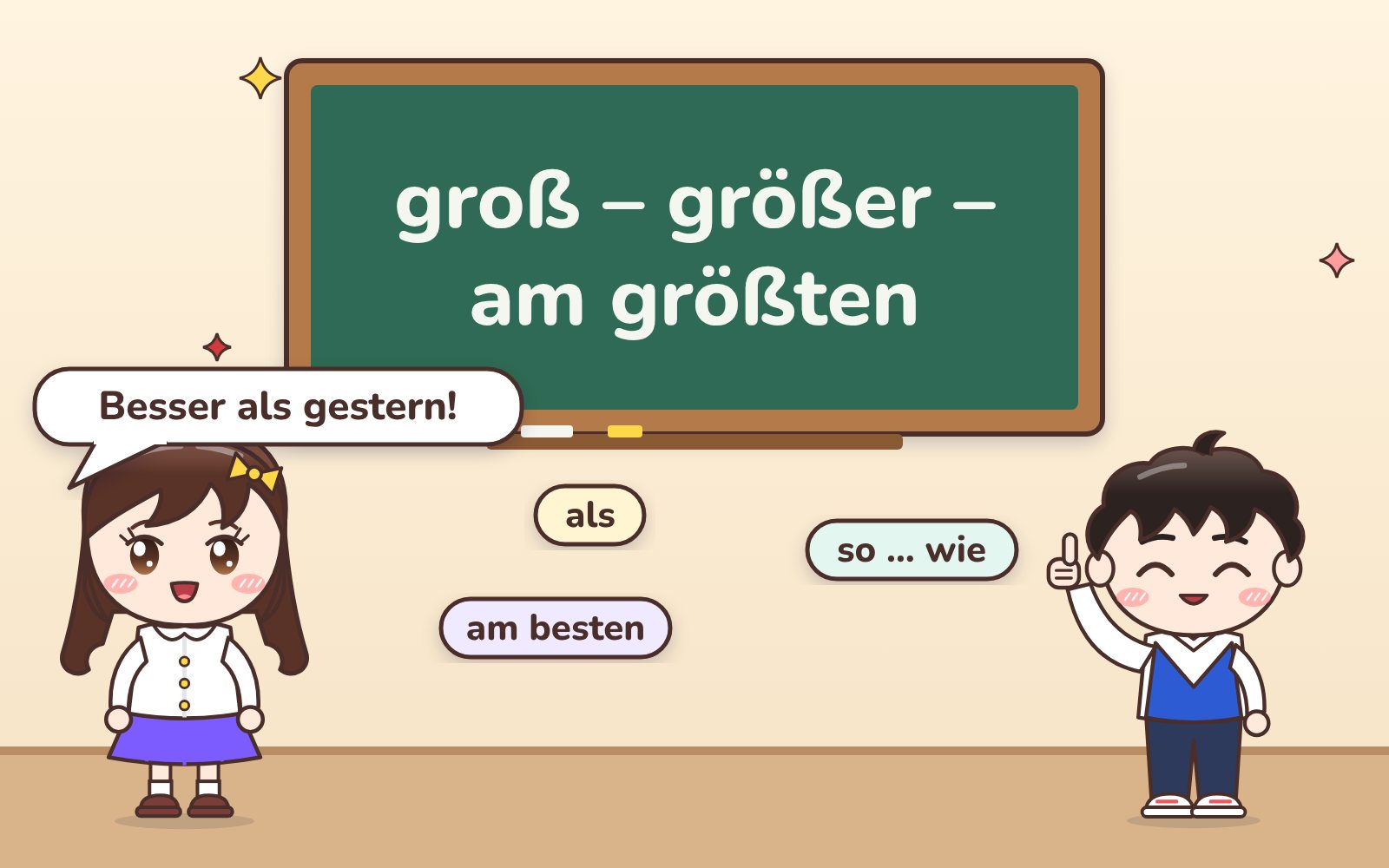
"Which one is cheaper?" at the supermarket, "What's the fastest way?" at the station, "I prefer tea to coffee" with friends — we compare things all day. Luckily German comparatives follow a simple pattern: add -er for "more" and use am … -sten for "most". There is no German version of more or most in front of long adjectives: however long the adjective, you just add the ending.
Comparative: adjective + -er, then als
"Than" is als. Add -er to the adjective and put als before what you compare with.
| Base | Comparative (more) | Superlative (most) |
|---|---|---|
| klein (small) | kleiner | am kleinsten |
| schnell (fast) | schneller | am schnellsten |
| billig (cheap) | billiger | am billigsten |
| teuer (expensive) | teurer | am teuersten |
| dunkel (dark) | dunkler | am dunkelsten |
Adjectives ending in -er or -el, like teuer and dunkel, drop an e in the comparative (teurer, dunkler).
- Der Bus ist billiger als das Taxi. — The bus is cheaper than the taxi.
- Heute ist es kälter als gestern. — It's colder today than yesterday.
- Mein Bruder ist älter als ich. — My brother is older than me.
- Die Wohnung ist teurer als die andere. — This flat is more expensive than the other one.
Superlative: am -sten and der/die/das -ste
After a verb, "the most …" is am … -sten. In front of a noun, use the article with -ste plus the usual adjective ending. If the adjective ends in -t, -d, -s, -ß, -z or -sch, add an e to make it easier to say: -esten (am kältesten, am kürzesten, am heißesten).
- Im Januar ist es hier am kältesten. — It's coldest here in January.
- Welches Ticket ist am billigsten? — Which ticket is the cheapest?
- Das ist der schnellste Weg zum Bahnhof. — This is the fastest way to the station.
- Berlin ist die größte Stadt Deutschlands. — Berlin is the biggest city in Germany.
Adjectives that take an umlaut: a, o, u → ä, ö, ü
Many short one-syllable adjectives add an umlaut in the comparative and superlative. Learning the common ones is enough.
| Base | Comparative | Superlative |
|---|---|---|
| alt (old) | älter | am ältesten |
| jung (young) | jünger | am jüngsten |
| groß (big) | größer | am größten |
| lang (long) | länger | am längsten |
| kurz (short) | kürzer | am kürzesten |
| warm (warm) | wärmer | am wärmsten |
| kalt (cold) | kälter | am kältesten |
groß ends in ß but is an exception: am größten (not größesten).
Fully irregular: gut, viel, gern
The most common words are the most irregular. Learn these five as a set.
| Base | Comparative | Superlative |
|---|---|---|
| gut (good) | besser | am besten |
| viel (much, many) | mehr | am meisten |
| gern (gladly, like to) | lieber | am liebsten |
| hoch (high) | höher | am höchsten |
| nah (near) | näher | am nächsten |
- Ich trinke lieber Tee als Kaffee. — I prefer tea to coffee.
- Am liebsten fahre ich mit dem Fahrrad. — Most of all I like going by bike.
- Mein Deutsch wird immer besser. — My German is getting better and better.
Equal: so … wie
For "as … as", use so + base form + wie; for "not as … as", nicht so … wie. To stress a comparative, put viel (much) or noch (even) in front.
- Der Zug ist so schnell wie das Auto. — The train is as fast as the car.
- Hamburg ist nicht so groß wie Berlin. — Hamburg isn't as big as Berlin.
- Das Hotel ist viel teurer. — The hotel is much more expensive.
- Morgen wird es noch kälter. — Tomorrow it'll get even colder.
Common mistakes
- ❌ Berlin ist größer wie München. → ✅ Berlin ist größer als München. (After a comparative, use als. Some people say wie in speech, but it counts as wrong in writing and exams.)
- ❌ Der Zug ist mehr schnell. → ✅ Der Zug ist schneller. (No mehr in front.)
- ❌ Das ist am guten. → ✅ Das ist am besten. (gut is irregular.)
Quick check
- Fill the gap: Ein Kaffee ist ___ als ein Cocktail. (billig)
Answer
billiger — Ein Kaffee ist billiger als ein Cocktail.- What are the comparative and superlative of gut?
Answer
besser, am besten- Fill the gap: Hamburg ist nicht so groß ___ Berlin.