German lessons · German grammar · A2
The German genitive
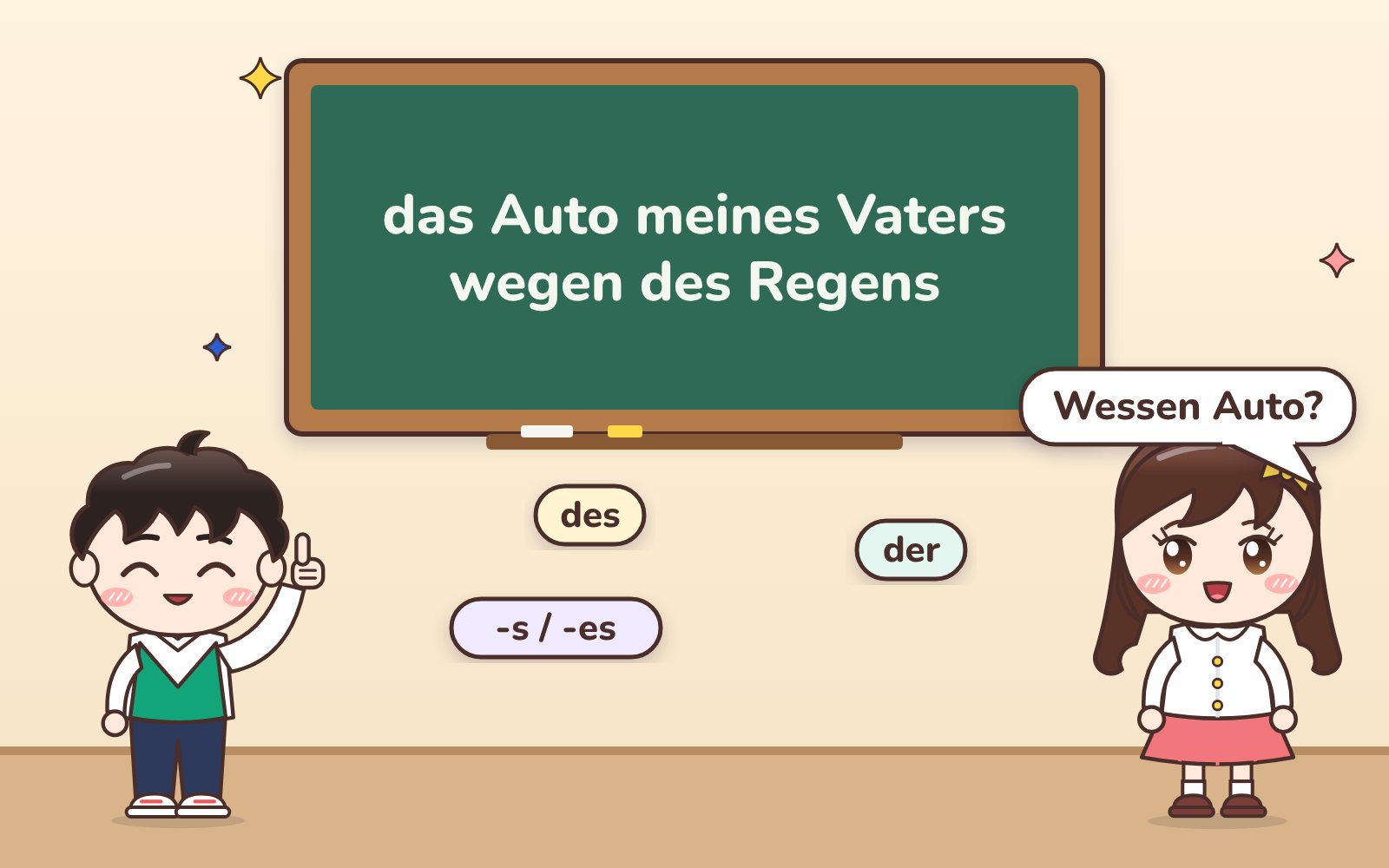
The genitive (Genitiv) answers Wessen? — "whose?". It works like "of" or the English 's. You hear it less in casual conversation, but it is everywhere in the news, official letters, signs and exams. Even the S-Bahn announcement "wegen einer Störung" (because of a fault) is genitive. Knowing the forms makes everyday reading in Germany much easier.
Genitive articles and the -s/-es ending
In the genitive, the masculine and neuter article becomes des, the feminine and plural article becomes der. Masculine and neuter nouns add -s or -es; feminine and plural nouns don't change. The genitive noun usually comes after the noun it describes.
| Masculine | Feminine | Neuter | Plural | |
|---|---|---|---|---|
| Definite | des Mannes | der Frau | des Kindes | der Kinder |
| Indefinite | eines Mannes | einer Frau | eines Kindes | — |
| Possessive | meines Vaters | meiner Mutter | meines Autos | meiner Eltern |
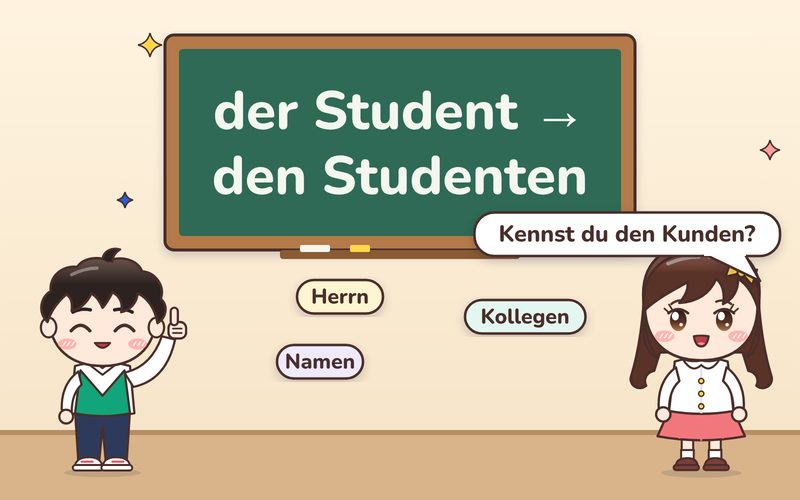
-es is used mostly with one-syllable nouns (des Tages, des Mannes) and is required after -s, -ß, -x, -z (des Hauses, des Platzes). Nouns with two or more syllables, or ending in -er, -el, -en, just take -s (des Lehrers, des Onkels, des Wagens). A few masculine nouns take -(e)n instead, like der Student → des Studenten.
- Das ist das Auto meines Vaters. — This is my father's car.
- Die Farbe des Hauses gefällt mir. — I like the colour of the house.
- Der Name des Hotels ist lang. — The hotel's name is long.
- Die Wohnung meiner Schwester ist klein. — My sister's flat is small.
- Die Zimmer der Kinder sind oben. — The children's rooms are upstairs.
Names in the genitive
Names take just -s, with no article, and the name comes first. Unlike English, there is no apostrophe. Only names ending in -s, -ß, -x, -z get an apostrophe.
| Name | Genitive | Example |
|---|---|---|
| Anna | Annas | Annas Handy |
| Peter | Peters | Peters Fahrrad |
| Klaus | Klaus' | Klaus' Wohnung |
- Annas Handy liegt auf dem Tisch. — Anna's phone is on the table.
- Wessen Jacke ist das? – Das ist Peters Jacke. — Whose jacket is this? – It's Peter's.
Prepositions with the genitive: wegen, trotz, während
wegen (because of), trotz (despite), während (during), plus statt (instead of) and innerhalb (within) take the genitive in written German. You'll see them constantly in notices and the news.
| Preposition | Meaning | Example |
|---|---|---|
| wegen | because of | wegen des Streiks |
| trotz | despite | trotz des Regens |
| während | during | während der Woche |
| statt | instead of | statt des Busses |
| innerhalb | within | innerhalb einer Woche |
- Wegen des Streiks fährt heute keine S-Bahn. — Because of the strike, there's no S-Bahn today.
- Trotz des Regens gehen wir spazieren. — We're going for a walk despite the rain.
- Während der Woche habe ich wenig Zeit. — During the week I have little time.
- Statt des Busses nehme ich das Fahrrad. — I'm taking the bike instead of the bus.
- Innerhalb einer Woche bekommen Sie eine Antwort. — You will get an answer within a week.
In speech, many people say wegen dem Regen with the dative. That's fine in conversation, but in letters, emails and exams the genitive is the safe choice.
In speech: von + dative
In everyday conversation, Germans very often replace the genitive with von + dative. The meaning is the same. You also need von when a genitive isn't possible, for example with plural nouns that have no article.
| Written (genitive) | Spoken (von + dative) |
|---|---|
| das Auto meines Vaters | das Auto von meinem Vater |
| die Wohnung meiner Schwester | die Wohnung von meiner Schwester |
| — | die Meinung von Experten |
- Das ist das Auto von meinem Vater. — This is my father's car.
- Ich habe die Nummer von Annas Bruder. — I have Anna's brother's number.
Common mistakes
- ✗ die Wohnung des Frau → ✓ die Wohnung der Frau (feminine genitive article is der)
- ✗ das Büro des Lehrer → ✓ das Büro des Lehrers (masculine and neuter nouns add -s)
- ✗ Anna's Handy → ✓ Annas Handy (no apostrophe with German names in the genitive, as a rule)
Quick check
- Das ist das Büro ___ Chefs. (der Chef)
Answer
Das ist das Büro des Chefs. — Masculine: article des, and the noun adds -s.- ___ Regens bleiben wir zu Hause. (wegen, der Regen)
Answer
Wegen des Regens bleiben wir zu Hause.- Das Fahrrad ___ ist neu. (meine Tochter)