German lessons · German grammar · B1
Das Paket wird geliefert: the German passive, when what happens matters more than who
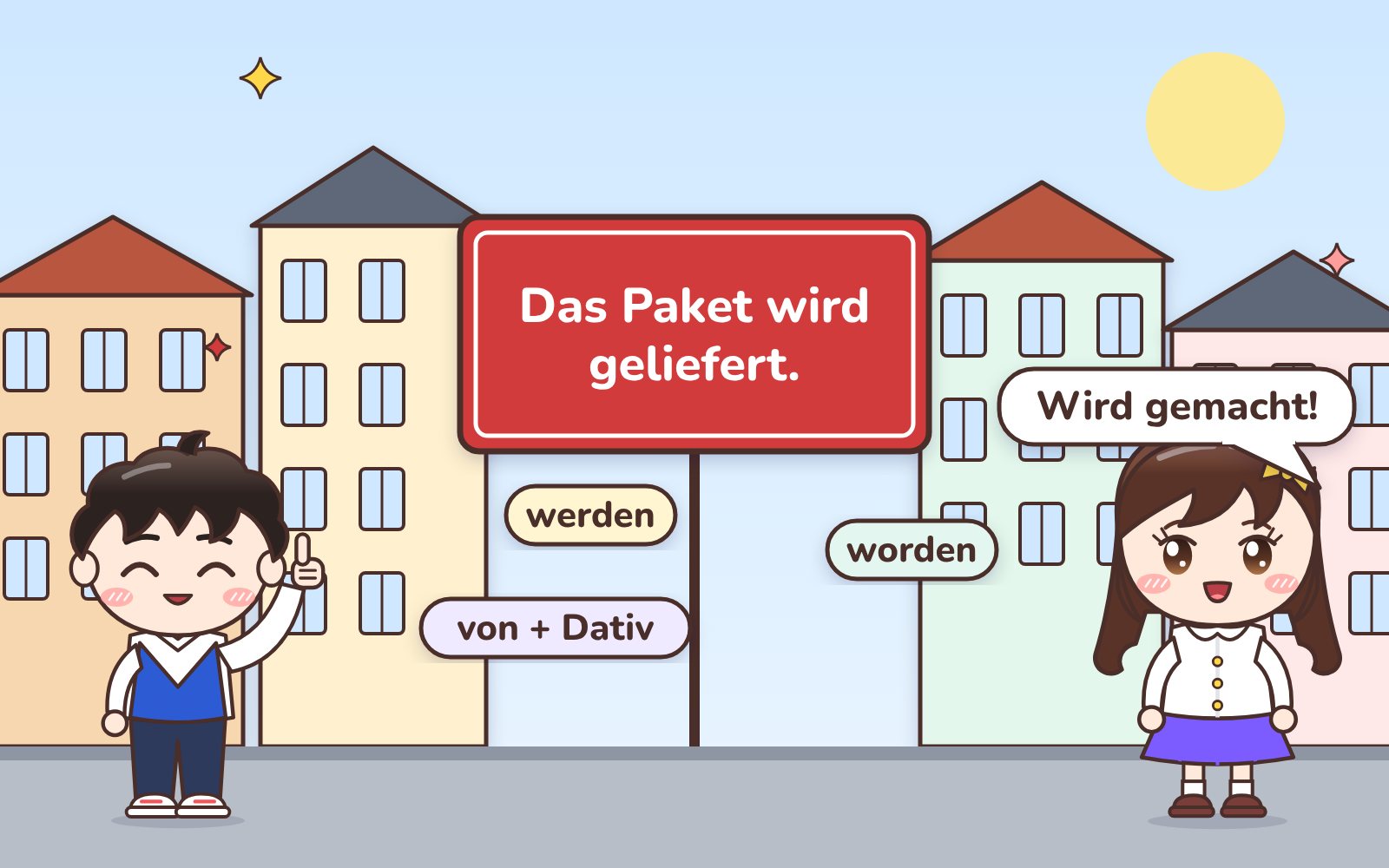
Your parcel notification says Ihr Paket wird heute zugestellt. (Your parcel will be delivered today), and your rental contract says Die Wohnung wurde 2020 renoviert. (The flat was renovated in 2020). Who delivers or who renovated hardly matters. When what happens is more important than who does it, German uses the passive (das Passiv). You'll find it everywhere in official letters, the news and notices. There is one formula: werden + past participle (Partizip II), with the participle at the very end of the sentence.
The basic shape: werden + past participle
The accusative object of the active sentence becomes the nominative subject of the passive sentence.
| Active (Aktiv) | Passive (Passiv) |
|---|---|
| Der Techniker repariert die Heizung. | Die Heizung wird repariert. |
| Man öffnet den Laden um 8 Uhr. | Der Laden wird um 8 Uhr geöffnet. |
| Die Post liefert die Pakete. | Die Pakete werden geliefert. |
- Die Heizung wird morgen repariert. — The heating will be repaired tomorrow.
- Hier wird viel Deutsch gesprochen. — A lot of German is spoken here.
- Die Formulare werden online ausgefüllt. — The forms are filled in online.
Notice how den Laden (accusative) becomes der Laden (nominative). With a plural subject, the verb is werden.
Three tenses
| Tense | Form | Example |
|---|---|---|
| Present | werde/wirst/wird … + participle | Das Haus wird gebaut. |
| Präteritum | wurde/wurdest/wurden … + participle | Das Haus wurde 1905 gebaut. |
| Perfekt | sein + participle + worden | Das Haus ist 1905 gebaut worden. |
- Der Brief wurde gestern verschickt. — The letter was sent yesterday.
- Mein Antrag ist schon bearbeitet worden. — My application has already been processed.
In stories and writing, the passive past is almost always wurde. In the Perfekt the auxiliary is sein, and the last word is worden, not geworden. This is the trickiest part of the passive.
Saying who did it: von + dative
To name the person, use von + dative. For a cause or a means, you can also use durch + accusative.
- Der Kuchen wurde von meiner Oma gebacken. — The cake was baked by my grandma.
- Die Rechnung wird vom Vermieter geschickt. — The bill is sent by the landlord. (von + dem = vom)
- Die Straße wurde durch den Sturm beschädigt. — The road was damaged by the storm.
With modal verbs: muss … werden
With müssen, können, dürfen, sollen and other modal verbs, the sentence ends in participle + werden (infinitive).
- Der Antrag muss bis Freitag abgegeben werden. — The application must be handed in by Friday.
- Das Ticket kann online gekauft werden. — The ticket can be bought online.
- Hier darf nicht geraucht werden. — Smoking is not allowed here.
Action or result: werden and sein
werden + participle describes the action (something is being done); sein + participle describes the resulting state. The second is called the state passive (Zustandspassiv).
- Die Tür wird um 22 Uhr geschlossen. — The door is closed at 10 pm. (someone closes it)
- Die Tür ist geschlossen. — The door is closed. (its state now)
And werden + infinitive is not the passive but the future: Ich werde arbeiten. (I will work) vs Ich werde gefragt. (I am asked). The future is explained in the future with werden.
Common mistakes
- ❌ Das Paket ist geliefert geworden. → ✅ Das Paket ist geliefert worden. (The passive Perfekt uses worden.)
- ❌ Die Heizung hat repariert worden. → ✅ Die Heizung ist repariert worden. (The auxiliary is sein.)
- ❌ Den Computer wird repariert. → ✅ Der Computer wird repariert. (The passive subject is nominative.)
- ❌ Der Brief wurde von mein Chef unterschrieben. → ✅ Der Brief wurde von meinem Chef unterschrieben. (von takes the dative.)
Quick check
- Make it passive (present): Man repariert das Fahrrad.
Answer
Das Fahrrad wird repariert.- Put it in the Perfekt: Das Formular wurde unterschrieben.
Answer
Das Formular ist unterschrieben worden.- Fill the gap: Die Briefe ___ gestern verschickt. (Präteritum)