German lessons · German grammar · A1
Separable Verbs (anrufen, aufstehen)
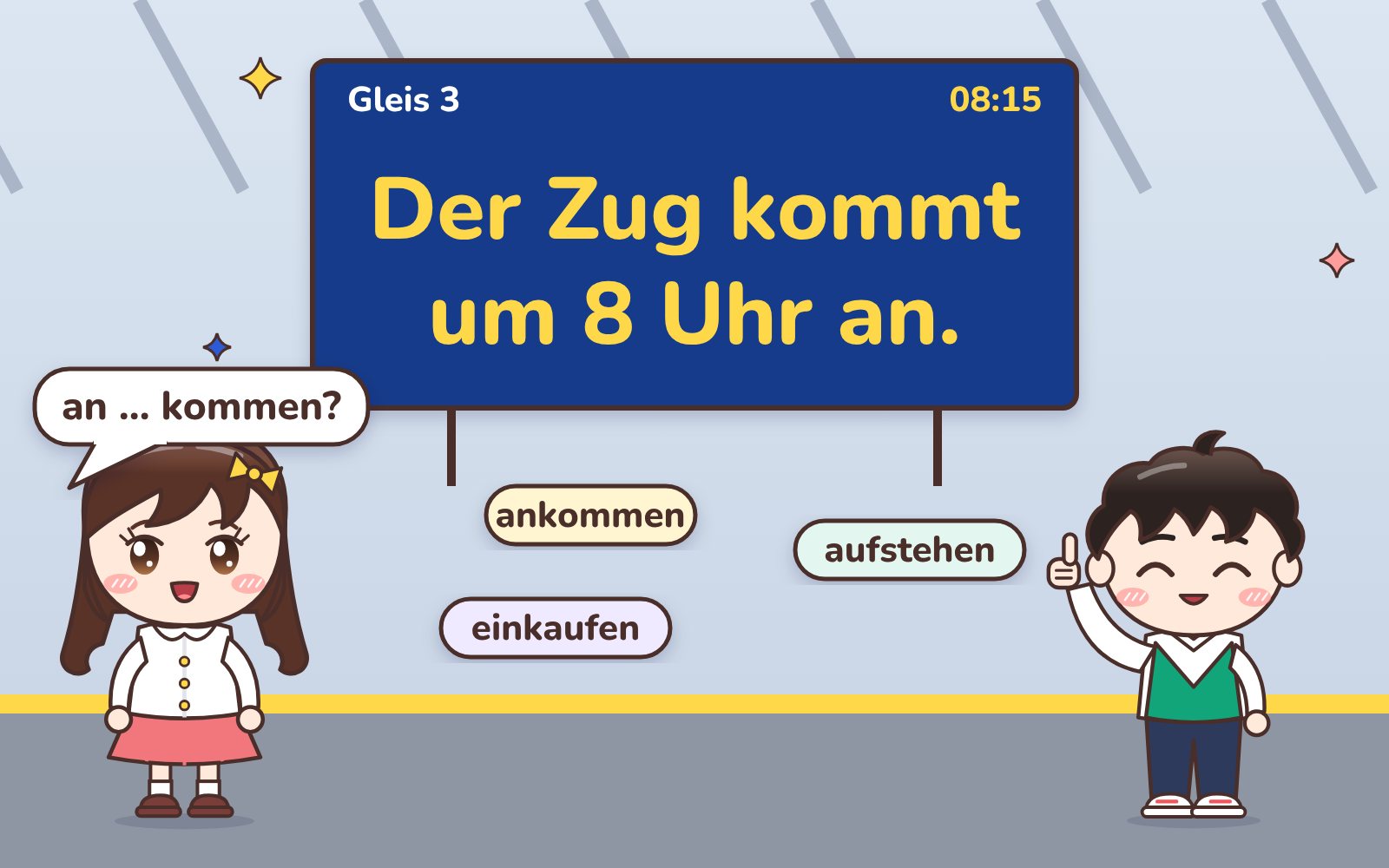
Many everyday German verbs have a small prefix: anrufen (to call), einkaufen (to shop), aufstehen (to get up), mitkommen (to come along), abholen (to pick up). In a normal sentence the prefix breaks off and jumps to the very end, so learners often miss it while listening, or forget it while speaking. They work a bit like English phrasal verbs (call up, pick up, get up), but the German particle goes all the way to the end of the clause.
Main clauses: the prefix goes to the end
The verb stem is conjugated in position 2 as usual. The prefix waits at the end of the sentence.
| Infinitive | ich | er / sie | Meaning |
|---|---|---|---|
| anrufen | ich rufe … an | er ruft … an | to call |
| einkaufen | ich kaufe … ein | sie kauft … ein | to shop |
| aufstehen | ich stehe … auf | er steht … auf | to get up |
| mitkommen | ich komme … mit | sie kommt … mit | to come along |
| abholen | ich hole … ab | er holt … ab | to pick up |
- Ich stehe um sieben Uhr auf. — I get up at seven.
- Rufst du mich morgen an? — Will you call me tomorrow?
- Wir kaufen am Samstag im Supermarkt ein. — We go shopping at the supermarket on Saturday.
- Kommst du mit? — Are you coming along?
- Ich hole dich um acht ab. — I'll pick you up at eight.
With modal verbs and in subordinate clauses: back together
When the verb itself stands at the end, nothing is split. With a modal verb (können, müssen, wollen …) the infinitive goes to the end in one piece. In a subordinate clause (dass, wenn, weil …) the conjugated verb goes to the end, again in one piece.
| Situation | Example |
|---|---|
| Main clause | Ich rufe dich an. |
| With a modal verb | Ich will dich anrufen. |
| Subordinate clause | …, dass ich dich anrufe. |
| Subordinate clause + modal | …, dass ich dich anrufen will. |
- Ich muss morgen früh aufstehen. — I have to get up early tomorrow.
- Kannst du mich vom Bahnhof abholen? — Can you pick me up from the station?
- Ich weiß, dass du heute einkaufst. — I know that you're going shopping today.
- Ich komme mit, wenn ich Zeit habe. — I'll come along if I have time.
- Er sagt, dass er mitkommen will. — He says that he wants to come along.
Perfect tense: ge- goes in the middle
In the past participle, ge- comes between the prefix and the stem: angerufen, not geanrufen. Verbs of movement or change of state such as aufstehen and mitkommen use sein.
| Infinitive | Perfect |
|---|---|
| anrufen | hat angerufen |
| einkaufen | hat eingekauft |
| abholen | hat abgeholt |
| aufstehen | ist aufgestanden |
| mitkommen | ist mitgekommen |
- Ich habe dich gestern angerufen. — I called you yesterday.
- Wir haben schon eingekauft. — We've already done the shopping.
- Ich bin um sechs aufgestanden. — I got up at six.
- Hast du die Kinder abgeholt? — Did you pick up the kids?
- Bist du mitgekommen? — Did you come along?
Contrast: inseparable prefixes
The prefixes be-, ver-, er-, ent-, zer-, ge-, emp-, miss- never separate, and their participle has no ge-. A useful hint: separable prefixes are stressed (ANrufen), inseparable ones are not (verSTEhen).
| Verb | Present | Perfect |
|---|---|---|
| besuchen (to visit) | ich besuche | hat besucht |
| verstehen (to understand) | ich verstehe | hat verstanden |
| erklären (to explain) | ich erkläre | hat erklärt |
| entschuldigen (to excuse) | ich entschuldige | hat entschuldigt |
| zerstören (to destroy) | ich zerstöre | hat zerstört |
| gefallen (to please) | es gefällt mir | hat gefallen |
| empfehlen (to recommend) | ich empfehle | hat empfohlen |
| missverstehen (to misunderstand) | ich missverstehe | hat missverstanden |
- Ich verstehe die Frage nicht. — I don't understand the question.
- Wir besuchen am Sonntag unsere Oma. — We're visiting our grandma on Sunday.
- Der Film gefällt mir. — I like the film.
- Hast du das verstanden? — Did you understand that?
- Der Lehrer hat das Wort erklärt. — The teacher explained the word.
Common mistakes
- ✗ Ich anrufe dich morgen. → ✓ Ich rufe dich morgen an.
- ✗ Ich habe dich geanruft. → ✓ Ich habe dich angerufen.
- ✗ Ich habe das geverstanden. → ✓ Ich habe das verstanden.
Quick check
- Make a sentence: ich / morgen / einkaufen (present tense).
Answer
Ich kaufe morgen ein.- Put into the perfect: Er holt mich ab.
Answer
Er hat mich abgeholt.- Complete: Ich weiß, dass er um sechs ___ (aufstehen).